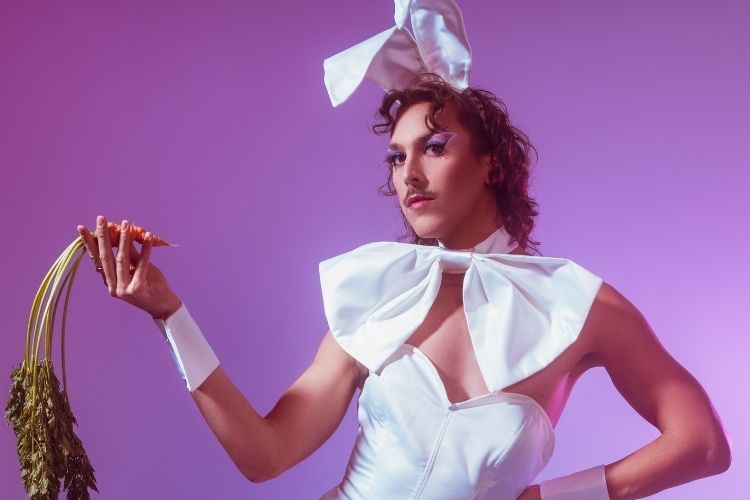

Directed by Patrick Kennedy for New Theatre as part of Sydney Gay And Lesbian Mardi Gras, 'Perfect Arrangement' uses comedy to pull audiences into a story about fear, conformity, and the cost of hiding.
The show opens in the rhythms of a 1950s sitcom, bright smiles, broad characters, a cocktail party that feels pulled straight from 'I Love Lucy'. But that familiarity is deliberate misdirection. “The challenge is presenting something that’s madcap sitcom but also has these undertones of drama,” Kennedy says. “Knowing when those shifts happen, what the acting looks like, how the lighting changes the mood. That’s what interested me.”
Set in April 1950, 'Perfect Arrangement' centres on two lavender marriages working inside the US State Department during the Lavender Scare, a lesser-known counterpart to McCarthyism that saw queer government employees interrogated, outed, and fired. Kennedy admits he hadn’t fully grasped the scale of that history himself. “Everyone knows about the Red Scare,” he says. “But this idea that queer people were seen as easily bribed, that they were a national security risk, that was fascinating and horrifying to unpack.”
Although Topher Payne wrote the play about a decade ago, Kennedy says its relevance has sharpened rather than faded. What once felt like a historical reflection now lands as a warning. “Government encroaching on private lives, dictating relationships, belief systems,” he says. “Ten years later, that doesn’t feel distant at all.”
Kennedy’s approach to character leans into recognisable archetypes before complicating them. The bombastic government official, the perfect housewife, the dutiful secretary, the sensitive school teacher. “I wanted the audience to grasp them immediately,” he explains. “Then over the course of the play, they gain colour and complexity.” That evolution is supported by a highly stylised set that functions as a kind of pressure chamber.
Rather than a naturalistic apartment, the stage is designed like a TV studio, complete with studio lights and a rigidly ordered colour palette drawn from the American flag. “The set is the eighth character,” Kennedy says. “When outsiders come in, the big studio lights snap on and it becomes a performance. When they leave, the lights drop and we return to something private.”
One of the play’s most pivotal lines is about staying meaning the loss of belief that life could be better. For Kennedy, it’s a call to arms, both within the play and beyond it. “Hiding away destroys your belief system,” he says. “Those characters are choosing between safety and the very early gay rights movement of the 1950s.”
Yet 'Perfect Arrangement' refuses a clean, triumphant ending. Three characters leave to fight. One remains behind, unable to overcome the shame society has drilled into him. “Progress happened for some,” Kennedy says. “But not for everyone. And that’s not because he’s weak. It’s because of what’s been done to him.”
For Kennedy, that unresolved tension is the point. He hopes audiences leave feeling empowered, but also unsettled. “History doesn’t look kindly on oppressors, or those who help them,” he says. “And unless everybody is on board, somebody is always left behind.”
If 'Perfect Arrangement' uses laughter as an entry point, it’s because Kennedy believes comedy makes the truth harder to ignore. “It’s not depressing,” he insists again. “It’s fun. But it’s also asking what we do now, with the freedom we’ve inherited, and who we’re still leaving behind.”
'Perfect Arrangement' is on at New Theatre 4 February-7 March.